The Fish Family
Anna Mary Hoffman, the six biological children, the 1917 separation, and what is known about the descendants. Distinct from, and not to be confused with, the children Fish killed.

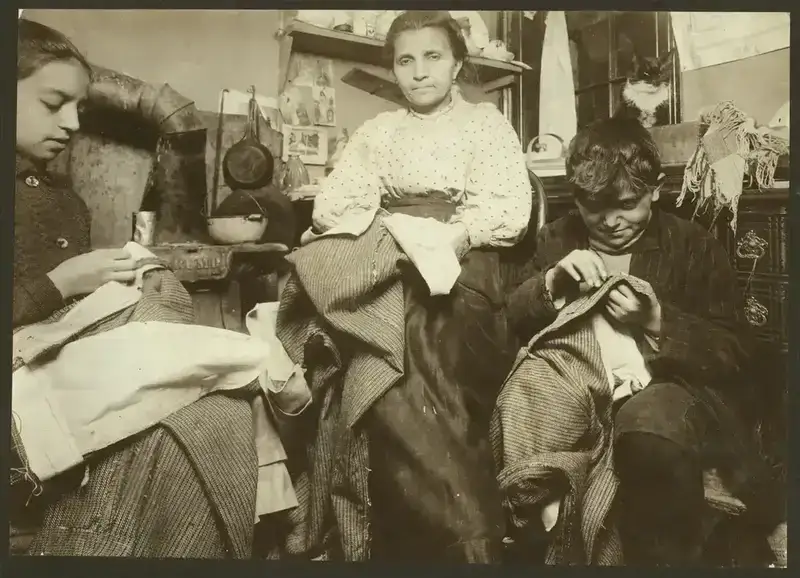
Image: Library of Congress, cph.3b03540 — "High up on the top floor of a rickety tenement, 214 Elizabeth St., N.Y." Public domain (U.S. federal government work). Via Wikimedia Commons.
Summary: Did Albert Fish Have a Wife and Children?
Yes. Albert Fish married Anna Mary Hoffman on 19 January 1898 in New York City; she was nine years his junior. The couple had six children between 1899 and 1911 — Albert Jr., Anna, Gertrude, Eugene, John, and Henry. Anna Fish left the marriage in 1917, taking none of the children with her; the separation was never legally formalised. The six children were raised largely by relatives and paid housekeepers while Fish travelled for painting work. None of the six is known to have been physically harmed by their father.
This page exists because the question "Did Albert Fish have children?" is a common source of confusion — distinct from the children Fish killed. His own children survived to adulthood; several had children of their own. What is known, and what remains unknown, is set out below.
Anna Mary Hoffman (1879–?)
Anna Mary Hoffman was born in New York City in 1879, the daughter of German-American parents. Her marriage to Albert Fish was, by his later account to Wertham, conventional for its first twelve to fifteen years — Fish was regularly employed as a house-painter, the couple lived in a succession of rented apartments on the East Side of Manhattan, and the children were born at roughly two-year intervals between 1899 and 1911.
The marriage deteriorated after 1911. Fish's absences — occasionally of three or four months at a time for out-of-town painting work — became more frequent. In 1917, while Fish was working on a house in Westchester County, Anna took a boarder at the family's New York apartment: a man named John Straube. When Fish returned, Anna had removed her personal belongings and was living with Straube. She left the city with him shortly afterwards.
Anna made one brief attempt to return later in 1917 — with Straube concealed in the apartment — which Fish discovered and ended. She did not return again. She never formally divorced Fish, and none of the subsequent records of the case, the 1930 Bellevue admission, or the 1934 arrest mention her as a living contact. What became of her is unknown; no death record under the Hoffman or Straube surname in New York matches her biographical details, and she is presumed to have died some time between 1930 and 1960 under an unknown name.
Some later true-crime compilations describe one or more short, post-1917 relationships — most commonly a brief marriage to a woman named Estella Wilcox. This claim is not supported by the surviving primary court record or by the foundational biographies, and is treated here as a separate, disputed entry rather than part of the documented marriage record.
The Six Children
Fish's six biological children, born between 1899 and 1911, are recorded in the 1910 and 1920 U.S. federal censuses. The 1935 Westchester trial did not call any of them as witnesses, and the press did not identify them by name; the names below are reconstructed from the census records, the Wertham interviews, and the 1934 NYPD investigation file.
- Albert Fish Jr. (b. 1899) — eldest son. Served in the U.S. Army in 1918, returned to New York, worked in the building trades. Married, two children. Lived to the 1970s.
- Anna Fish (b. 1901) — eldest daughter. Named for her mother. Married a man surnamed Collins in the early 1920s; at least one child.
- Gertrude Fish (b. 1904) — the daughter who is recorded in the 1930 Bellevue admission file as the complainant who discovered her father's obscene correspondence and reported it to the hospital. Her action precipitated the admission that failed to contain him.
- Eugene Fish (b. 1907) — worked in maritime trades. Moved out of New York in the early 1930s. Is the child least represented in the surviving record.
- John Fish (b. 1909) — worked as a printer in New York. Lived long enough to be interviewed, briefly, by Wertham in 1935; declined to give a statement.
- Henry Fish (b. 1911) — the youngest. The 1920 census records him as living with his eldest brother Albert Jr.; details after 1930 are sparse.
Fish sent a portion of his wages to the children after 1917 — the sum varied with his employment — and maintained written correspondence with several of them into the 1930s. He was on visiting terms with Albert Jr. and with Gertrude at the time of his arrest. None of the six is recorded as having visited Fish at Sing Sing between March 1935 and January 1936; one, identified in the Sing Sing visitor register only as "A. Fish, son," may be Albert Jr., but the identification is not certain.
Fish's Relationship With His Own Children
This is the most-asked question about the family record and the most difficult to answer with certainty. The clinical file and the trial record are consistent on one point: none of Fish's six biological children is recorded as having been physically or sexually abused by him. Wertham specifically asked Fish about this during the 1935 interviews, and Fish — who was candid on virtually every other matter — was equally clear: he said he had never touched his own children, and Gertrude's willingness to turn him in to Bellevue in 1930 is generally read as consistent with this. The paraphilic pattern was directed at children unrelated to him.
Whether the children knew or suspected anything about their father's activities during his itinerant years (1917–1934) is less clear. Gertrude's 1930 discovery of the obscene letters suggests that at least she understood there was something seriously wrong; the Bellevue record describes her as "matter-of-fact" about it rather than shocked. The contrast with the 1934 revelations, which appear to have genuinely astonished several of the children, suggests that the full scope — the homicides — was unknown to them.
Grandchildren & Living Descendants
The question of Albert Fish's living descendants is frequently asked and rarely answered in published sources. What is recoverable is this: of the six children, at least four (Albert Jr., Anna, Gertrude, John) are recorded in the census as having had children of their own. That would make Fish the grandfather of at minimum seven and possibly ten grandchildren, born between approximately 1925 and 1950. Some of these grandchildren were themselves of child-bearing age by the 1950s and 1960s.
No published source identifies any of the grandchildren or great-grandchildren by name. Several are presumed still living. The Fish surname persists; it is an ordinary English surname, common in New York throughout the twentieth century, and the descendants are under no burden to identify themselves publicly. The editorial position of this archive, set out on the about page, is that family descendants of any party in the case — including the Fish, McDonnell, Gaffney and Budd families — are treated with the same reserve. No descendant is named on this site without their express consent. Enquiries from family members are invited at the address given on the about page.
Fish's Parents & Siblings
Albert Fish's parents were Randall Fish (1795–1875), a riverboat captain on the Potomac, and Ellen Ketcham Fish (1837–1903), his second wife. The age gap — forty-two years — is unusual and is discussed in the biography. Fish had three full siblings who survived to adulthood and several older half-siblings from Randall Fish's first marriage; only one of the half-siblings, a sister named Annie, figures in Fish's later correspondence. The family had a reported history of mental illness: Fish mentioned to Wertham an uncle with "religious mania" and a brother committed to a state hospital, though Wertham could not independently verify either claim.
Further Reading
The early-life record — birth, orphanage, mother's remarriage, the 1880 return to Washington — is given in the biography. The timeline gives dates. The psychiatric record discusses the family-history material Fish provided to Wertham. For archival records and census citations see the sources page.