Hamilton Howard "Albert" Fish
Painter, drifter, father of six, and one of the most extensively studied serial offenders in American criminal history. A biographical record drawn from primary sources, hospital admission records, and contemporaneous press coverage.

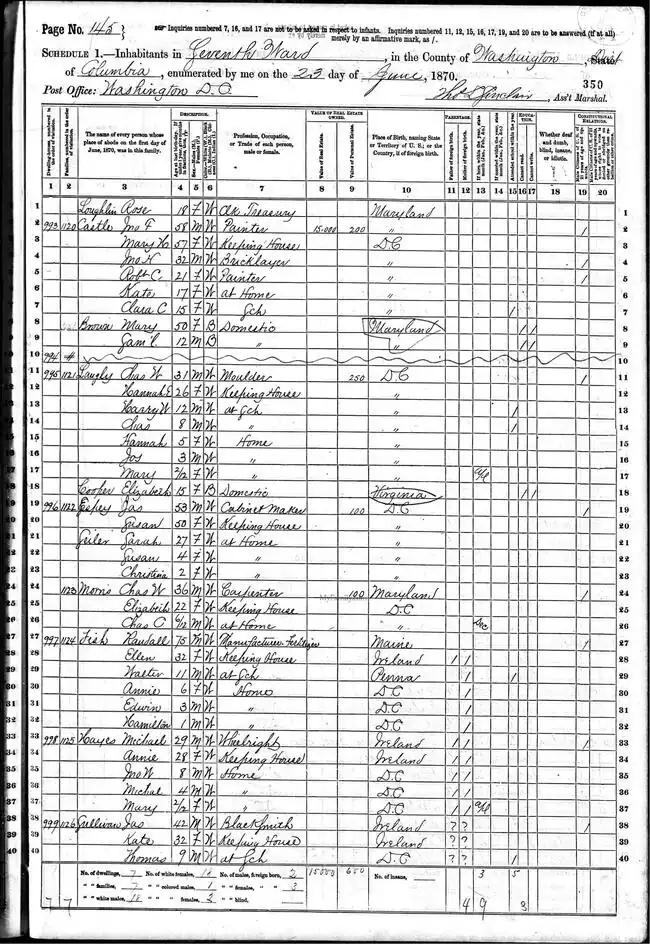
Image: United States Census Bureau, 1870. Public domain (U.S. federal government work). Via Wikimedia Commons.
Birth & Origins (1870–1879)
Hamilton Howard Fish was born on 19 May 1870 in Washington, D.C., the youngest of four surviving children of Randall Fish, a riverboat captain then aged seventy-five, and Ellen Ketcham Fish, his second wife, aged thirty-two. Randall Fish died of a heart attack at the Sixth Street Wharf in Washington on 16 October 1875, when Hamilton was five. Ellen Fish, left in reduced circumstances, placed the child at St. John's Orphan Asylum in Washington in 1879.
Fish later told Dr. Wertham that it was at the orphanage, between the ages of nine and eleven, that the patterns which governed the rest of his life took shape. The institution's corporal-punishment regime — regular beatings and whippings before the assembled children — produced, by his own account, a persistent association between physical pain and sexual arousal. The admission is recorded in Wertham's The Show of Violence (1949, ch. 4) and is consistent with Fish's later paraphilic behaviour.
New York (1890–1917)
Ellen Fish reclaimed her son from the orphanage in 1880. He attended public school in Washington, then worked briefly as a Western Union telegraph messenger. In 1890, aged twenty, he moved to New York City, where he would remain for most of the next forty-five years. He found regular employment as a house-painter — a trade he would never formally leave — and changed his given name from "Hamilton" to "Albert" in honour, he said, of a deceased sibling.
On 19 January 1898 he married Anna Mary Hoffman, nine years his junior. They had six children between 1899 and 1911: Albert Jr., Anna, Gertrude, Eugene, John, and Henry. Fish travelled frequently for painting work, sometimes for several months at a time. The marriage ended in 1917 when Anna left him for a boarder, John Straube, taking none of the children. The separation was never formalised.
The Wandering Years (1917–1928)
After 1917 Fish lived an increasingly itinerant life: a rented room in Manhattan's theatre district for a few weeks, a boarding-house in Brooklyn for a month, a job on a country house in New Jersey for a season. He continued to send a portion of his wages to his children, who remained largely with relatives. During these eleven years he accumulated arrests in New York, New Jersey, Virginia, and Delaware — most for petty fraud (passing bad cheques), one for obscene correspondence (1903, New York), one for a minor larceny. None resulted in substantial imprisonment. Some later true-crime sources also describe one or more short relationships in this period, including a disputed brief marriage to Estella Wilcox, though none of these is firmly established in the primary record.
It is also in this period that Fish's known homicidal pattern begins. The confirmed first killing — Francis McDonnell, Staten Island, 15 July 1924 — occurred when he was fifty-four. The second, Billy Gaffney, followed in February 1927. The third, Grace Budd, in June 1928.
Aliases
Fish used a succession of false names across the period 1919–1934, some for fraud and some for the purpose of approaching families with children. The best-documented are:
- "Frank Howard, farmer, Farmingdale, L.I." — the name given to the Budd family in May 1928.
- "John W. Pell" — used in correspondence to a Westchester realtor regarding Wisteria Cottage, 1927.
- "Robert Hayden" — used in a series of obscene letters sent to widows in 1929–1933.
- "Thomas Sparling" — used when he rented the room at 200 East 52nd Street, New York, in October 1934.
The press, once the case broke in December 1934, gave him a further set of names — the Gray Man, the Brooklyn Vampire, the Werewolf of Wysteria, the Moon Maniac. These are treated separately on the press aliases page.
The Arrest (December 1934)
Fish was arrested on 13 December 1934 at the rooming-house on East 52nd Street. The capture, and the six-year investigative trail that ended there, is described in detail on the dedicated arrest page and summarised in the entry on the Grace Budd letter. He was sixty-four years old.
The widely reproduced Albert Fish mugshot — the three-quarter intake photograph taken at the Missing Persons Bureau on East 21st Street on the evening of 13 December 1934 — belongs to this moment. The NYPD signed intake card for that date, countersigned by Detective King, bears Fish's own signature: the cramped cursive "Albert H. Fish" that also appears on the foot of the 1934 letter to Delia Budd. Both the mugshot and the signature card are preserved in the Westchester County trial exhibits.
Trial & Execution (1935–1936)
Fish was tried in the Westchester County Court for the Budd murder in March 1935, convicted after a ten-day trial and approximately three hours of jury deliberation, and sentenced to death. After three successive postponements of the execution date, he was electrocuted at Sing Sing on 16 January 1936. His official prisoner number was 83909. He was sixty-five.
A Note on the Psychiatric Record
Fish was examined in life by four psychiatrists: Menas Gregory (Bellevue, 1930, for the 1903 obscenity matter); Frederic Wertham (1935, for the defence); Smith Ely Jelliffe (1935, for the prosecution); and Charles Lambert (1935, for the prosecution). Wertham's account is the most extensive and is the basis for most subsequent biographical treatments. The three other examiners produced shorter reports preserved in the Westchester County trial exhibits.
See sources for the full bibliography.
Further Reading
Independent, non-Wikipedia sources vetted at the time of publication. External links open in a new window.
- Albert Fish — Murderpedia case file — Comprehensive case aggregator with court records and press clippings.
- New-York Historical Society — Primary repository for New York City records of the 1880s–1930s.
See: the victims, press aliases, the pelvic X-ray, the execution, chronological timeline. Return to the main archive.