The Arrest of Albert Fish
How Albert Fish was caught: a six-year NYPD investigation, a stationer's receipt book, and a single letter. The capture at the East 52nd Street rooming-house on 13 December 1934.

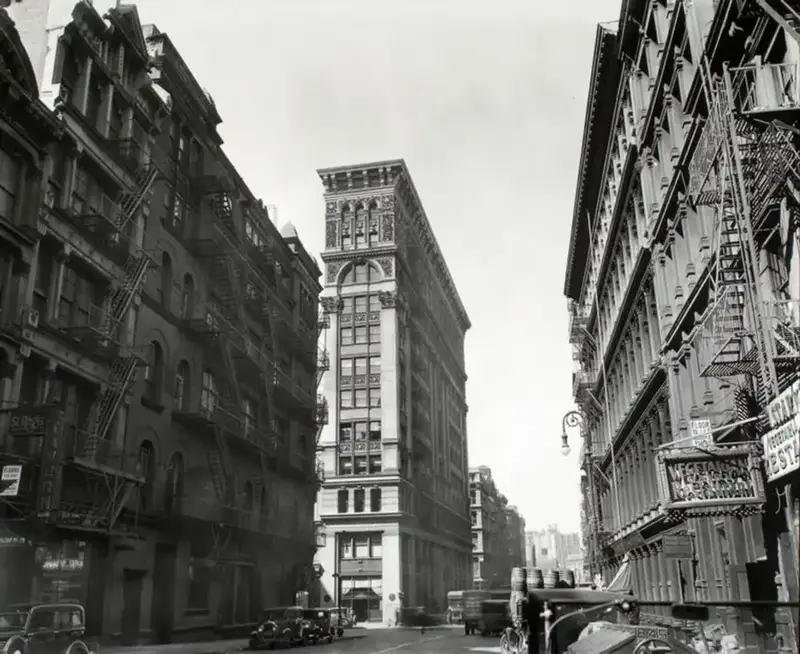
Image: Manhattan streetscape near Broome Street (photographer unknown, early 20th century). Public domain / no restrictions. Via Wikimedia Commons.
Short Answer: How Was Albert Fish Caught?
Albert Fish was caught because he wrote his confession on stolen letterhead and the letterhead was traceable. On 11 November 1934, six years after the disappearance of Grace Budd, Fish mailed the child's mother an anonymous letter describing the killing. The envelope bore a small hexagonal emblem — the monogram of the New York Private Chauffeurs' Benevolent Association — left over from a pad of stationery Fish had taken from a rooming-house he no longer lived in. Detective William F. King traced the emblem to the association, obtained the membership book, cross-referenced the names against a rooming-house register, and followed a forwarding address to 200 East 52nd Street. Fish was arrested there on 13 December 1934, approximately thirty-two days after the letter was received.
The Letter That Ended It (11 November 1934)
For six years the Budd case had been Detective King's private obsession. The investigation had been formally open since June 1928, had been the subject of a New York Daily News reward campaign in 1930, and had produced approximately four hundred leads, none of them productive. In early November 1934 the Budd family received a piece of mail that changed that.
The letter is the document preserved as Trial Exhibit 4 and is described in full on the Grace Budd letter page. Its forensic significance, for the purposes of the arrest, was not what it said — the confessional content — but where it had been written. On the envelope, lightly impressed into the paper in the upper-left corner, was a small embossed hexagon with the letters "N.Y.P.C.B.A." inside it. The family's attorney, Samuel Parsons, noticed the embossment. The letter and envelope were turned over to the NYPD Missing Persons Bureau on 13 November 1934.
The Hexagon: N.Y.P.C.B.A.
Detective King traced the hexagonal monogram within forty-eight hours. It belonged to the New York Private Chauffeurs' Benevolent Association, a small mutual-aid fraternity for professional drivers headquartered in Manhattan. The association was cooperative: it produced its membership book and its stationery-order ledgers. Cross-referencing the two, King established that a batch of the letterhead had been delivered to the association's building in the summer of 1934 and that several sheets were missing from the supply closet.
The janitor at the N.Y.P.C.B.A. building, interviewed on 20 November, recalled that a former lodger at a rooming-house on 52nd Street had left a pad of the stationery behind when he moved out. The lodger had been known to the janitor as an older painter who did occasional work in the building; his name, as given on the rooming-house register, was Albert H. Fish.
The East 52nd Street Room
The rooming-house on the north side of East 52nd Street — no. 200, above a chop-house — kept the forwarding addresses of its departed tenants. Fish's forwarding card, signed in his own hand, gave a new address on the opposite side of the same block: a smaller rooming-house where he had taken a single second-floor room in October 1934 under the name Thomas Sparling. King placed the building under observation on 11 December.
Fish returned to the room on the afternoon of 13 December 1934. King and two uniformed officers knocked. Fish opened the door, admitted his identity on being shown the Budd letter and his own handwriting from the rooming-house register, and, after a brief ineffectual lunge at King with a straight razor, was subdued and taken into custody. He was sixty-four years old.
The Interrogation
Fish was booked at the Missing Persons Bureau on East 21st Street in the early evening. He confessed to the Budd killing in approximately ninety minutes. Over the following seventy-two hours he made further statements — in the presence first of King, then of an assistant district attorney, then of a stenographer — that produced the confession statement preserved as Trial Exhibit 12 and treated separately on the confession letter page.
In those three days Fish also admitted, unprompted, to the killings of Francis McDonnell (1924) and Billy Gaffney (1927). The first was confirmed by the Richmond County District Attorney's office using physical evidence recovered from the 1924 crime scene; the second was corroborated by Brooklyn DA records and the detailed 1927 letter that was still in the Brooklyn file.
Detective William F. King
William F. King had been a detective with the NYPD Missing Persons Bureau since 1919 and was the lead investigator on the Budd case from the day of Grace Budd's disappearance in June 1928. The Budd case was known within the department as "the Gray Man file," and King was its keeper for six years. He had interviewed the Budd family more than fifty times and had personally followed at least sixty of the approximately four hundred leads received between 1928 and 1934. The stationery trace was his.
King was the principal prosecution witness at the March 1935 Westchester trial. He retired from the NYPD in 1942 and died in New York in 1961. A brief obituary in the New York Times on 18 October 1961 credits him as "the detective who solved the Budd case."
Why It Took Six Years
Three investigative problems kept the Budd case open from 1928 to 1934.
- No body. Grace Budd's remains were not recovered until Fish's December 1934 confession directed investigators to them at Wisteria Cottage in Westchester County. Without a body, the case could not be prosecuted as a homicide.
- The Frank Howard alias. Fish had presented himself to the Budds under a false name ("Frank Howard, farmer, Farmingdale, L.I."). The telegram address and the rural-New-York background were fabrications; there was no Frank Howard. NYPD inquiries at Farmingdale established only that no farmer of that name lived there.
- No fingerprint database for itinerants. Fish's prior arrests — for petty fraud, obscene correspondence, and larceny — existed in file drawers in four different states but had never been consolidated. His pattern of letters to widows and families, which would have been conspicuous in any modern behavioural review, was invisible in the paper-based systems of the 1920s.
The Budd case was, as King later put it to the New York Post, "solved by an envelope." It is probable that without the November 1934 letter, Fish would not have been identified in his lifetime.
Further Reading
The letter itself, with a high-resolution transcription, is treated in full on the Budd letter page. The confession that followed the arrest is on the confession statement page. The house where Fish had taken Grace Budd is on the Wisteria Cottage page. A dated chronology of the arrest and prosecution is on the timeline.