The Pelvic X-Ray
Twenty-nine sewing needles, inserted over decades of self-punishment, as documented in Fish's 1935 pre-trial radiograph

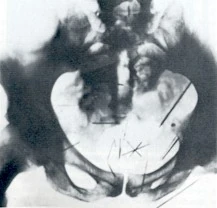
Image: Westchester County trial exhibit, March 1935. Author unknown. Public domain in the United States (published 1931–1977 without copyright notice). Via Wikimedia Commons.
What the X-Ray Showed
In early 1935, during the court-ordered psychiatric examination that preceded Albert Fish's trial for the murder of Grace Budd, a radiograph was taken of his pelvis at the request of his psychiatrist, Dr. Frederic Wertham. The plate revealed twenty-nine sewing needles embedded in the tissues of the groin, perineum, and lower pelvic floor. Some were whole; others had broken into short fragments and migrated within the surrounding muscle.
Wertham had not asked for the X-ray because he expected needles. He had asked for it because Fish, in interview, had described a lifelong habit of inserting them into his own body. Wertham wanted objective confirmation that the claim was literal rather than delusional. The plate confirmed it was literal.
How Long the Practice Had Been Going On
Fish told Wertham that he had begun the practice in his forties, some time around 1910, and had continued it at irregular intervals until shortly before his arrest in December 1934. He described inserting the needles — ordinary household sewing needles, occasionally hatpins — as an act of self-punishment and, in his own words, of religious purification. The insertions were sometimes followed by repeated self-flagellation with a nail-studded paddle Fish referred to as his "instrument of Hell." The paddle itself was recovered from the East 52nd Street rooming-house at the time of his arrest and became a separate trial exhibit.
The X-ray pattern was consistent with Fish's description. The needles were not grouped at a single insertion point but distributed across a wide area, with older fragments clearly calcified and newer needles intact and unrusted. Wertham's monograph The Show of Violence (1949, pp. 77–79) describes the distribution in detail.
At Trial
The radiograph was entered into evidence at the Westchester County Courthouse in March 1935 as Exhibit 7. It was used in support of Wertham's testimony that Fish was criminally insane — specifically, that the chronic self-harm demonstrated an entrenched paraphilic disorder of many decades' standing, not a recent derangement.
The prosecution did not contest the authenticity of the X-ray. It argued instead that self-harm and legal insanity were distinct questions, and that a defendant could be both capable of monstrous self-injury and fully responsible for his actions toward others. The jury accepted the prosecution's distinction; Fish was convicted on 22 March 1935 and electrocuted at Sing Sing on 16 January 1936.
Why the Image Survived
Unlike most trial exhibits of the 1930s, the Fish X-ray was published — first in a restrained form in Wertham's pre-war case papers, then in full in the 1949 monograph, and subsequently in the American and European psychiatric literature, where it became one of the most reproduced single radiographs in twentieth-century forensic medicine. It is the image most often associated with the case in popular memory, often reproduced without its clinical context.
The radiograph is usually referred to in the press as the "Albert Fish x-ray," "the needles x-ray," or simply "the 29 needles." A number of the needles remained in Fish's body at the time of his execution; others had worked free over the years and were discarded.
The Broader Pattern
In the year between his arrest and his execution, Fish described to Wertham and to prison physicians a repertoire of self-inflicted practices that extended beyond the needles. He told interviewers he had, on various occasions, driven pins under his own fingernails; pressed burning cotton wool into his groin; and sat on a nail-studded board. Some of these claims were corroborated by the trial medical examinations; others were not.
A short list of related queries directs readers to pages that cover adjacent aspects of the case: the full biographical context, the press-given aliases including "the Moon Maniac," the confession statement, and the execution at Sing Sing.
Further Reading
Independent, non-Wikipedia sources vetted at the time of publication. External links open in a new window.
- Albert Fish — National Museum of Crime & Punishment — Museum case file including commentary on the trial exhibits.
- Psychiatry — Psychology Today — Background on the clinical framework Wertham worked within.
Primary source: Wertham, The Show of Violence (Doubleday, 1949), pp. 77–79. Secondary: Schechter, Deranged (1990), ch. 14. See full sources & bibliography or return to the main archive.