The Victims of Albert Fish
Three confirmed homicides. Two strongly suspected. Several more claimed. The formal accounting of the children Albert Fish killed, maimed, or was never charged with.

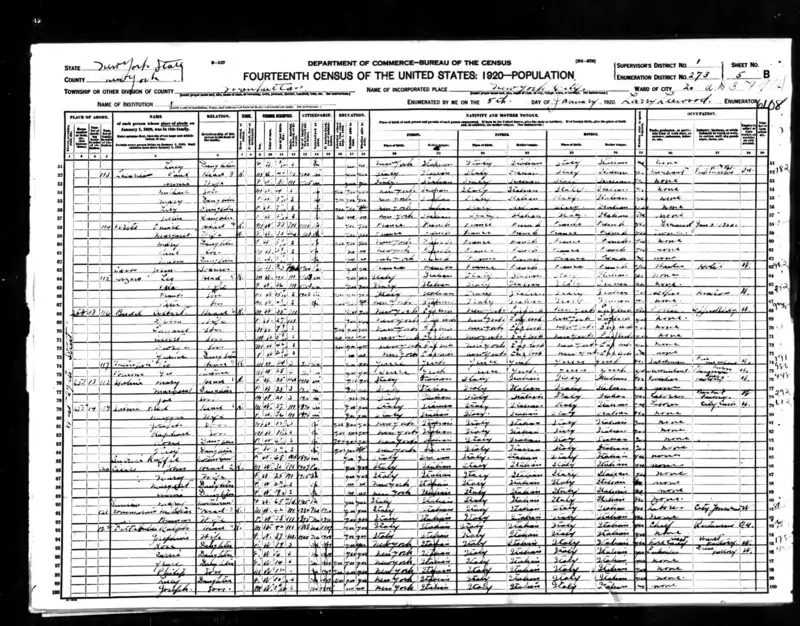
Image: United States Census Bureau, 1920. Public domain (U.S. federal government work). Via Wikimedia Commons.
Key Questions Answered
How many people did Albert Fish kill?
Three confirmed. Francis McDonnell (1924), Billy Gaffney (1927), and Grace Budd (1928). Investigators linked Fish to at least two more disappearances, and Fish himself claimed roughly one hundred killings — a figure historians treat as pathological boasting, not evidence.
Who was Albert Fish's first victim?
Eight-year-old Francis McDonnell of Staten Island, taken on 15 July 1924 when Fish was fifty-four. Fish would not confess to the killing until eleven years later, after his 1934 arrest in the Budd case.
Who did Albert Fish kill?
Three children aged four to ten: Francis McDonnell (8), Billy Gaffney (4), and Grace Budd (10). Two further children — Emma Richardson (Washington D.C., 1926) and an unnamed Staten Island child — are strongly suspected but never charged.
Did Albert Fish kill his own children?
No. Fish had six biological children with his wife Anna Mary Hoffman. None was physically or sexually harmed by him. Wertham's 1935 interviews and the Bellevue file are consistent on this point. For the family record, see the family page.
How This Page Counts
Albert Fish admitted to Dr. Frederic Wertham and to Detective William King that he had assaulted or killed "about one hundred" children between 1910 and his arrest in 1934. The estimate is characteristic of pathological boasting and is not accepted in the serious historical record. What is accepted — what prosecutors proved or what investigators documented with physical or confessional evidence — is much smaller.
This page distinguishes three categories: confirmed (charged or formally admitted with corroborating physical evidence); strongly suspected (admitted by Fish and consistent with the investigative record, but never charged); and claimed (self-reports with no independent corroboration). The three confirmed victims are the basis for every serious biographical treatment of the case.
Confirmed Victims
Francis McDonnell — 15 July 1924
Eight years old. Son of a Staten Island patrolman, Arthur McDonnell, and his wife Anna. Francis was playing on the front porch of the family home at 321 Richmond Avenue, Port Richmond, when he was approached by a tall, grey-haired man in threadbare clothing. Witnesses described the stranger as muttering to himself. Francis was led away and never seen alive again. His body was found two days later in a wooded area of the Lattingtown Wood, roughly half a mile from the house, hanged from a tree. The case sat open for eleven years. Fish confessed to it in writing in early 1935.
Billy Gaffney — 11 February 1927
Four years old. Son of a Brooklyn transit worker, William Gaffney Sr., and his wife Elizabeth. Billy disappeared from the hallway outside a neighbour's apartment at 99 15th Street, Brooklyn, in the late afternoon. He had been playing with a three-year-old friend, Billy Beaton, who was later found alone and, under questioning by his mother, described a "boogey man" who had taken Billy away. The phrase entered the case file and from there the New York press. Fish confessed to Elizabeth Gaffney by letter in 1935.
Grace Budd — 3 June 1928
Ten years old. Daughter of Edward and Delia Budd of 406 West 15th Street, Manhattan. Grace was taken from the family apartment in the company of a grey-haired stranger who called himself Frank Howard and who had answered a job advertisement placed in the New York World by her older brother. He represented himself as a prospective employer taking Grace to a children's birthday party in Brooklyn. In fact he took her by train and taxi to Wisteria Cottage near Worthington, New York, and killed her there. The case remained open until the 1934 letter to Delia Budd.
Strongly Suspected, Not Charged
Emma Richardson — 1926
Five years old. Disappeared in the Washington, D.C. area in 1926 and was never found. Fish claimed the killing to Wertham but gave inconsistent details of location and date. The Washington Metropolitan Police Department reviewed the file after Fish's 1934 arrest and declined to pursue charges in the absence of a body or of any verifiable physical evidence.
The unnamed Staten Island case — 1924
Fish admitted, separately from the McDonnell confession, to an attempted but unfinished attack on a second Staten Island child in the summer of 1924. No identifying details were ever corroborated, and investigators concluded that the admission may have been a composite memory of the McDonnell case.
Thomas Kedden — Wilmington, 1910 (claimed)
Fish described to Wertham an assault on a teenage labourer, Thomas Kedden, in Wilmington, Delaware, around 1910. Fish's version of the killing was lurid and detailed, and is quoted in Wertham (1949). Delaware authorities, questioned during the 1935 trial preparation, could find no missing-person record matching the claim. The victim's name does not appear in any contemporaneous police file. Historians treat the Kedden account as, at minimum, unverifiable; the possibility that Fish fabricated the victim's name is taken seriously in Schechter (1990).
Cyril Quinn — claimed, 1919
A second claimed victim without corroboration. Fish gave Wertham the name "Cyril Quinn" and placed the killing in the New York metropolitan area around 1919. No missing-persons record matches. The name is treated by modern historians as uncorroborated.
Claims Without Corroboration
Fish told Wertham and, separately, Detective King, that he had committed attacks in at least twenty-three states over twenty years, including murders in Washington, D.C., Virginia, New Jersey, and Connecticut. None were independently verified. Contemporary investigators treated the larger figure as self-aggrandising rather than a factual admission, and The Show of Violence (1949) adopts the same editorial caution.
A broader treatment of the aliases Fish used during this period — "Frank Howard," "John W. Pell," and several others — is given on the biography page.
A Note on the Children
This archive's practice is to name the children, cite their families and their ages, and restrict the most explicit case particulars to the primary sources in which they are already preserved. The victims were not, and are not, a footnote to Fish's pathology. Readers interested in family-side accounts should consult the contemporaneous coverage in the New York Daily News (Grace Budd), the Brooklyn Daily Eagle (Billy Gaffney), and the Staten Island Advance (Francis McDonnell); all three papers' archives are accessible through the New York Public Library microfilm collection.
Further Reading
Independent, non-Wikipedia sources vetted at the time of publication. External links open in a new window.
- The Albert Fish case — All That's Interesting — Long-form editorial treatment of the confirmed killings.
Individual dossiers: Grace Budd, Billy Gaffney, Francis McDonnell. Return to the main archive or see primary sources.