On 3 June 1928 a ten-year-old girl named Grace Budd left her parents' apartment on 406 West 15th Street in the company of a courteous, grey-haired stranger who called himself Frank Howard. She was never seen alive again. Six years, five months and eight days later her mother Delia received an unsigned letter in the post. The letterhead on the envelope was the one mistake that would hang Albert Fish.
The record below follows the painter from his birth in 1870 to his execution in 1936. It draws on the Westchester County trial transcript, the 1935 Wertham psychiatric papers, and contemporaneous reporting in the New York Times, Herald-Tribune, and Daily News. For a year-by-year index, see the chronological timeline; for the standalone biographical essay, see the full Albert Fish biography.
Washington childhood and the orphanage, 1870–1890
Hamilton Howard Fish was born on 19 May 1870 in Washington, D.C., the youngest child of Randall and Ellen Fish. His father, a Potomac riverboat captain and fertiliser manufacturer roughly forty-three years older than his mother, died of a heart attack in 1875. Unable to keep the household together, Ellen placed the boy in Saint John's Orphanage in Washington. He later took the name "Albert" — by his own account to escape the schoolyard taunt of "Ham and Eggs" — and the name stayed with him for the rest of his life. In the psychiatric interviews Frederic Wertham conducted six decades later, the painter traced the origin of his lifelong association of pain with pleasure to the routine floggings of the orphanage. Whatever weight that self-report deserves, the institution is the first documented setting in which the later paraphilic disorder appears in his own narrative.
New York, marriage, and an outwardly ordinary life, 1890–1917
Fish moved to New York City in 1890 and took up the trade he would follow for four decades — house and interior painting, work that carried him between rooming-houses and job sites across all five boroughs and gave him an itinerant cover that later frustrated investigators. In 1898 his mother arranged his marriage to Anna Mary Hoffman, nine years his junior. The couple had six children and, by every external measure, lived an unremarkable working-class life in the city. Neighbours and employers who were interviewed after the 1934 arrest described a mild, courteous, grandfatherly man; none had suspected anything. That ordinariness — the gap between the public painter and the private offender — is one reason the case held such grip on the press, and why the Gray Man became the defining image of him. In January 1917 Anna left him for a boarder, John Straube, and the abandonment marked a turn: from this point the documentary record shows the behaviour described in the trial — episodes of self-mutilation, the insertion of needles, and the cruelties he inflicted on himself in private.
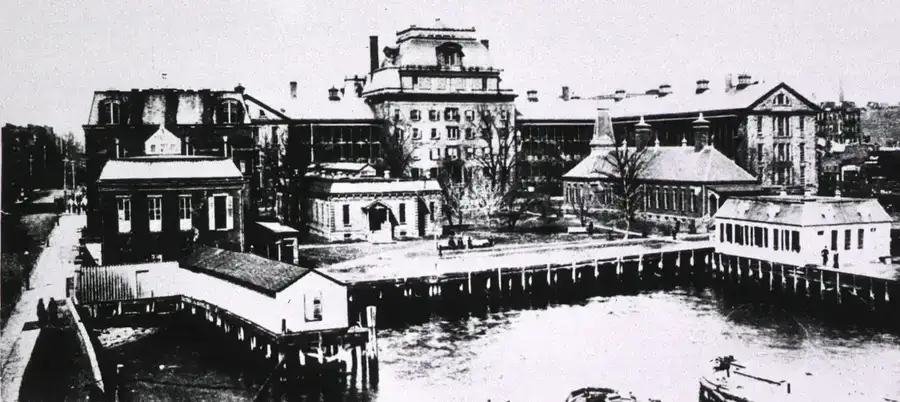
Image: Bellevue Hospital, New York City. Public domain (no copyright restrictions). Via Wikimedia Commons.
Bellevue Hospital, New York — where Fish was admitted in May 1930 on his daughter Gertrude's complaint, and from which he was discharged after observation as "not dangerous to others."
The documented murders, 1924–1928
Three killings are documented with physical or confessional evidence accepted at trial. The first was eight-year-old Francis McDonnell, taken on Staten Island on 14 July 1924; the boy's mother, Anna McDonnell, gave the description of an "old gray man" that supplied the killer's enduring nickname. The second was four-year-old Billy Gaffney, who vanished from a Brooklyn hallway on 11 February 1927 in a disappearance the press labelled the work of the "Brooklyn Vampire." The third, and the one that would finally identify him, was ten-year-old Grace Budd. On 3 June 1928 the painter presented himself to the Budd family of Manhattan as "Frank Howard," a farmer answering their son Edward's job advertisement. He won the family's trust over a single visit and left with Grace on the pretext of taking her to a children's party at his sister's home. He took her instead to Wisteria Cottage, a vacant house in Worthington, Westchester County, where he murdered her. The consolidated record of these and the suspected additional cases is set out on the victims page and across the wider account of the crimes.
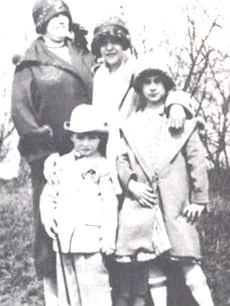
Image: Albert F. Budd Sr. / Asbury Park Press, 14 December 1934, p. 1. Public domain in the United States (published 1931–1977 without copyright notice). Via Wikimedia Commons.
Grace (right) with her mother and siblings. Photograph reproduced 14 December 1934.
The letter and the arrest, November–December 1934
For six years the Budd case went unsolved. What broke it was the killer's own hand. In November 1934 he sent Delia Budd, Grace's mother, an anonymous letter describing the murder in detail. The envelope carried a small embossed hexagonal emblem — the monogram of the New York Private Chauffeurs' Benevolent Association. Detective William F. King traced the emblem to the association, then to a former employee who had left the stationery behind at a Manhattan rooming-house, and from there to the room's current occupant. On 13 December 1934 the painter was arrested there, on East 52nd Street. The account of that trace is told in full on the how Albert Fish was caught page, with the surviving documents reproduced in the arrest file and the Budd letter entry.
Trial, the X-ray, and the psychiatric record, 1935
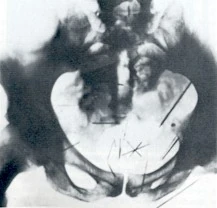
The trial opened on 11 March 1935 in the Westchester County Court at White Plains. The defence did not contest that the painter had killed Grace Budd; it argued that he was insane. Frederic Wertham, examining for the defence, catalogued a range of paraphilias and presented the now-famous evidence of self-injury — the Bellevue Hospital pelvic X-ray showing twenty-nine sewing needles the defendant had inserted into his own groin over many years. The prosecution conceded the abnormality but held that it did not meet the legal threshold for insanity under New York's M'Naghten standard. After ten days, the jury found him sane and guilty. Several jurors later said privately that they had believed him insane but had voted for conviction because they wanted him executed. The eleven-page confession statement he signed for the grand jury, and the full psychiatric evaluation, remain the case's central documents.
Image: Westchester County trial exhibit, March 1935. Author unknown. Public domain in the United States (published 1931–1977 without copyright notice). Via Wikimedia Commons.
The 1935 pelvic radiograph. Twenty-nine sewing needles, embedded over decades of ritual self-harm.
Sing Sing, 16 January 1936
Hamilton Howard Fish was electrocuted in the death house at Sing Sing State Prison in Ossining on the night of 16 January 1936; he was sixty-five. The executioner, Robert G. Elliott, recorded the event in his 1940 memoir Agent of Death. The competing newspaper and eyewitness accounts of that night — including the disputed question of his last words — are set against one another on the execution page. On the contested total number of victims, the archive's position is stated plainly: three murders are documented, the painter's own claim of "about one hundred" is unsupported and was treated by prosecutors as self-aggrandisement, and a small number of additional disappearances were investigated but never charged. Where the sources disagree, both are shown; see the bibliography for the full evidentiary basis.
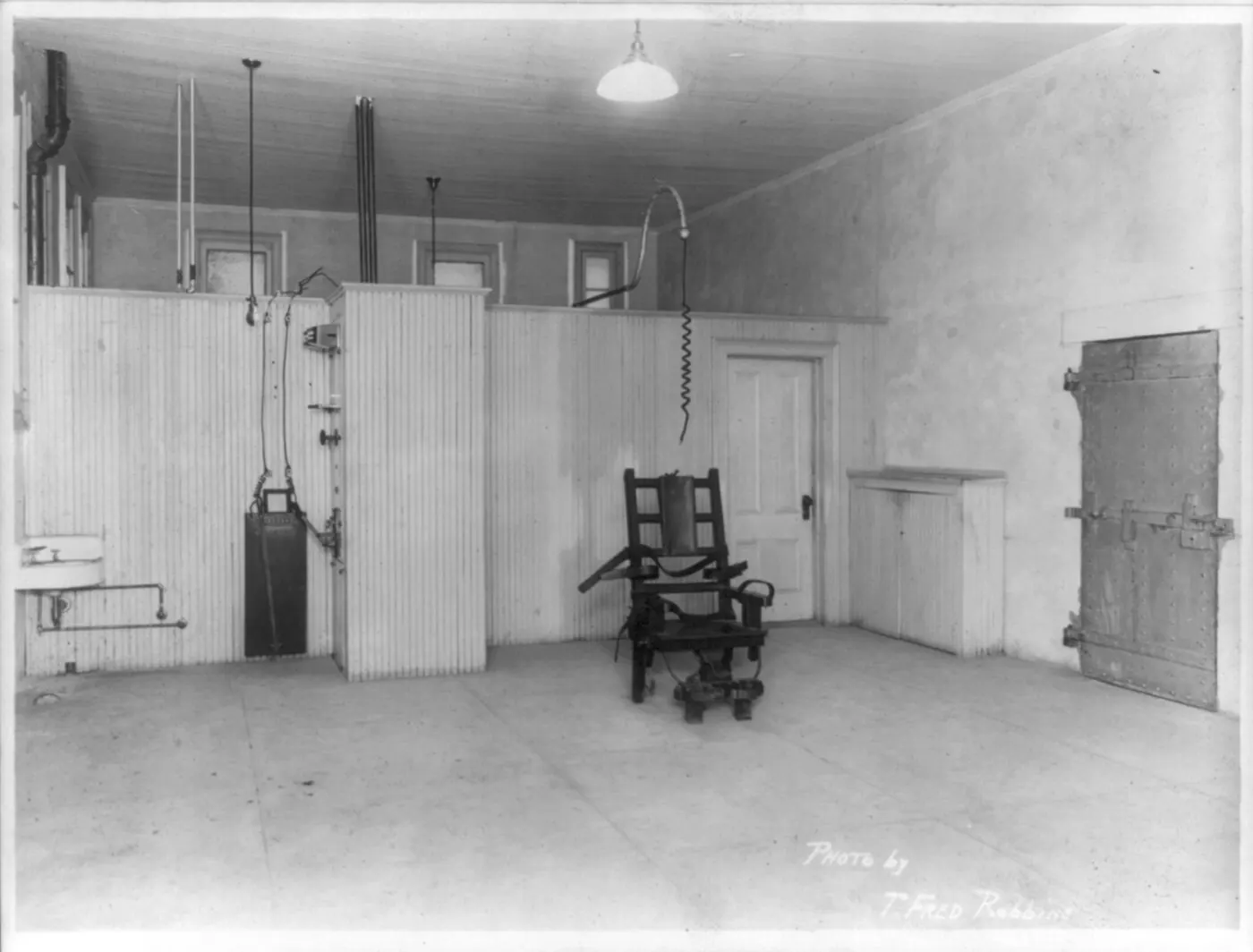
Image: T. Fred Robbins, Ossining, 1915. Library of Congress, LCCN 2012646357. Public domain in the United States. Via Wikimedia Commons.
The new electrocution chamber at Sing Sing, photographed in 1915.
The nicknames, the press, and the legacy
During the 1934–1935 investigation the New York press gave the painter six names: the Gray Man, the Boogeyman, the Brooklyn Vampire, the Moon Maniac, the Werewolf of Wysteria, and — in the cannibalism reporting — simply the Cannibal. The earliest, the Gray Man, came directly from Anna McDonnell's 1924 description of her son's abductor and predates the identification of Fish by a decade. The lasting significance of the case, however, rests less on the tabloids than on the medical record: Frederic Wertham's psychiatric evaluation became a foundational document in twentieth-century forensic psychiatry, and the pelvic X-ray remains one of the most-reproduced artefacts in the clinical literature on self-mutilation. The case has since been retold across books, documentary film, the screen, and true-crime tattoo art; the archive's bibliography records the principal accounts and the evidence behind each claim.
Selected sources and further reading
This page is compiled from primary records and the principal secondary literature. For the complete bibliography, see the archive's sources page; the authoritative external references below are a starting point for independent verification.
Last reviewed: ·
Editorial team: Bureau of Historical Research ·
Citation:Albert Fish Archive, albertfish.com, accessed .
Case OverviewREADING TIME · 5 MIN
Who was Albert Fish?
Albert Fish was an American serial killer, cannibal and child-murderer active in New York between 1924 and 1934. Born Hamilton Howard Fish on 19 May 1870 in Washington D.C., he was placed in St John's Orphanage at the age of nine following his father's death. Fish moved to New York City in 1890, worked as a house-painter across the boroughs for four decades, married Anna Mary Hoffman in 1898, fathered six children, and was abandoned by his wife in 1917. By the time of his arrest at a Manhattan rooming-house on 13 December 1934, Fish was sixty-four years old and wanted for the murder of ten-year-old Grace Budd. The full record of the Albert Fish crimes is documented in this archive. He was electrocuted at Sing Sing State Prison on 16 January 1936.
Why the case matters
The Albert Fish crimes are studied today for three reasons. First, the 1934 arrest turned on a single piece of physical evidence — the embossed hexagonal emblem of the New York Private Chauffeurs' Benevolent Association on an envelope flap — and remains one of the earliest American examples of forensic document tracing in a child-abduction investigation. Second, the 1935 psychiatric record, compiled by Dr Frederic Wertham for the defence, is a foundational document in twentieth-century criminal psychiatry; Wertham's case notes established the vocabulary of paraphilic disorder in American legal discourse. Third, the Albert Fish pelvic X-ray taken at Bellevue Hospital in March 1935 — which revealed twenty-nine sewing needles embedded in the groin region — is one of the most-cited artefacts in the forensic literature on self-mutilation.
What this archive contains
The Albert Fish Archive is a documentary record of the case, organised around the surviving primary sources. You will find:
Weekly editorial dispatches — short single-topic readings of individual documents and anniversaries in the case.
Editorial principles
Every page in this archive is written from primary sources — Westchester County Court records, the Wertham psychiatric papers held at Cornell, period press reporting in the New York Times, Herald-Tribune, and Daily News, and the surviving letters and forensic reports. Where a claim rests on a single source, we say so. Where the evidentiary picture is contested — as with the count of total victims, which Fish himself inflated to "about one hundred" — we present the competing accounts and indicate which is best supported by the documentary record. See the editorial policy and the full source list for the archive's research standards. The material is held for scholarly and historical research and is written with deliberate restraint out of respect for the victims and their descendants.
Last reviewed: ·
Editorial team: Bureau of Historical Research ·
Citation:Albert Fish Archive, albertfish.com, accessed .
Frequently AskedARCHIVE FAQ
Frequently asked questions about Albert Fish
Who was Albert Fish?
Albert Fish (Hamilton Howard Fish, 1870–1936) was an American serial killer, cannibal and child-murderer active in the New York metropolitan area between 1924 and 1934. Born in Washington D.C., he worked as a house painter in New York for four decades before his arrest on 13 December 1934 for the murder of ten-year-old Grace Budd. He was electrocuted at Sing Sing State Prison on 16 January 1936. Read the full Albert Fish biography.
How many victims did Albert Fish have?
Three murders are documented with physical or confessional evidence accepted at trial: Francis McDonnell (1924, aged 8), Billy Gaffney (1927, aged 4), and Grace Budd (1928, aged 10). Fish himself claimed at various points to have assaulted or killed "about one hundred" children, but contemporary prosecutors considered this figure self-aggrandising. Investigators privately linked him to several additional unsolved disappearances that were never formally charged. See the full Albert Fish victims page, the broader record of Albert Fish crimes, or the consolidated list of Albert Fish victims names.
How was Albert Fish caught?
Fish was caught through a forensic document trace. In November 1934 he sent a confession letter to Delia Budd, the mother of Grace Budd. The envelope bore a small embossed hexagonal emblem — the monogram of the New York Private Chauffeurs' Benevolent Association. Detective William F. King traced the emblem to the association within forty-eight hours. Thirty-two days after the letter arrived, Fish was arrested at a Manhattan rooming-house on East 52nd Street. Read the full account of how Albert Fish was caught and the Albert Fish arrest record.
What were Albert Fish's nicknames?
The New York press gave Fish six aliases during the 1934–1935 investigation and trial: the Gray Man, the Boogeyman, the Brooklyn Vampire, the Moon Maniac, the Werewolf of Wysteria, and — in later accounts — simply the Cannibal. The Gray Man was the earliest, derived from Anna McDonnell's 1924 description of the "old gray man" who took her son Francis. See the full Albert Fish nicknames page.
The 1935 pelvic X-ray taken at Bellevue Hospital, ordered by the psychiatrist Frederic Wertham, showed twenty-nine sewing needles embedded in the groin and pelvic region. Fish had inserted them himself over many years as an act of self-mutilation. The X-ray is one of the most-cited artefacts in the forensic literature on paraphilic disorder. See the full Albert Fish X-ray page.
Where was Albert Fish executed?
Albert Fish was electrocuted in the death house at Sing Sing State Prison in Ossining, New York, on 16 January 1936 at approximately 11:06 p.m. The executioner was Robert G. Elliott, New York State's official electrocutioner from 1926 to 1939. Fish was sixty-five years old. Read the full Albert Fish execution account.
What were Albert Fish's last words?
The executioner Robert G. Elliott records in his 1940 memoir Agent of Death that Fish, seated in the chair, said: "I don't even know why I am here." Contemporary press reports of 17 January 1936 differ — the New York Times described Fish as silent, while the Daily News reported a phrase consistent with Elliott's account. For the full record and the competing sources, see the Albert Fish last words page.
Four years old. Disappeared from a Brooklyn apartment hallway with a playmate who later described a "boogey man" in a grey coat. Fish confessed by letter to the mother in 1935.
Eight years old. Taken from Port Richmond on Staten Island by a tall, grey-haired stranger. Believed to be Fish's first homicide, though he would not be linked to it until after his arrest.
Case SummaryPROSECUTION FILE
How Many People Did Albert Fish Kill?
Fish claimed, at various points during his 1935 trial and in his jailhouse conversations with the psychiatrist Frederic Wertham, to have assaulted or killed "about one hundred" children. Contemporary prosecutors found the figure self-aggrandising. Three murders are documented with physical or confessional evidence accepted at trial: Francis McDonnell (1924), Billy Gaffney (1927), and Grace Budd (1928). Investigators in New York, Washington, and New Jersey privately linked him to several additional disappearances that were never formally charged. See the victims archive for the full accounting.
ExhibitMAR 1935
The Needle X-Ray
Twenty-nine sewing needles, embedded in the pelvis and groin over decades of self-inflicted ritual, visible on the 1935 radiograph.
Before his arrest Fish was known to New York and Brooklyn detectives by half a dozen press-given aliases: the Gray Man, the Boogeyman, the Brooklyn Vampire, the Werewolf of Wysteria, the Moon Maniac.
Fish was electrocuted at 11:06 p.m. on 16 January 1936 in the Sing Sing death house. Robert Elliott, the state executioner, required two applications of current.
External ReferenceCURATED LINK
Further Reading on the Sing Sing Period
Readers interested in the penal context of the case — the Ossining death house in which Fish's sentence was carried out — are referred to the Mob Museum's historical account of Sing Sing electrocutions: Dead Men Walking: Sing Sing executions.