The Letter to Delia Budd
Anonymous correspondence from Albert Fish to the mother of Grace Budd, six years and five months after the child's disappearance

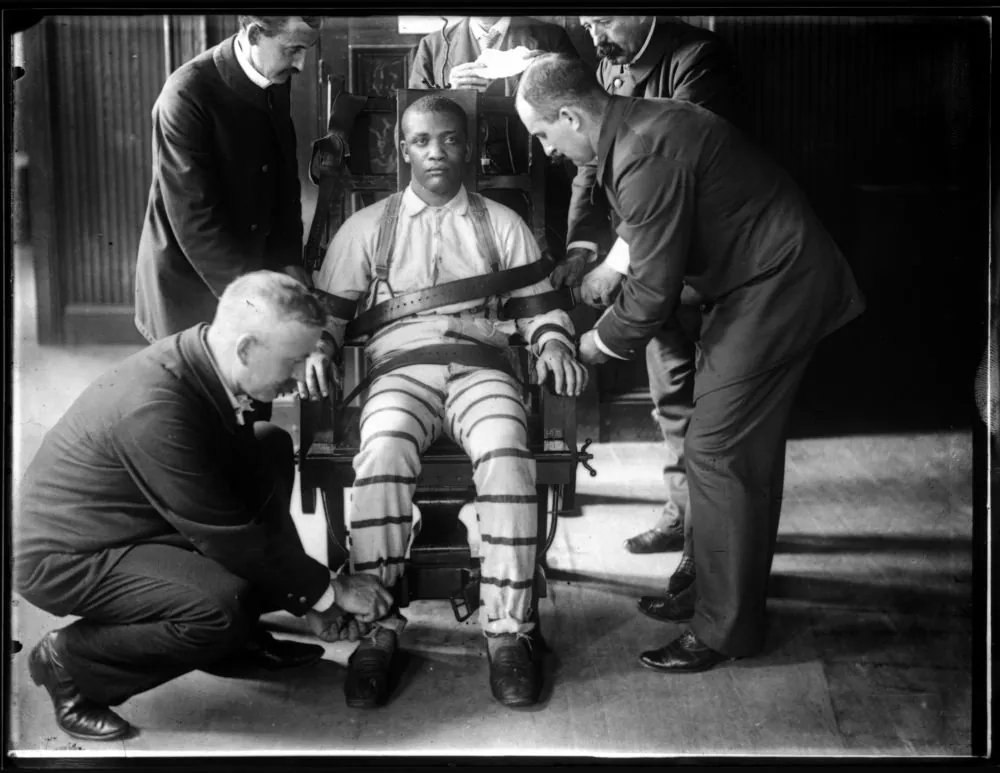
Image: William M. Vander Weyde (1871–1929), c. 1900. Public domain in the United States (pre-1928 publication). Via Wikimedia Commons.
The Arrival
On the afternoon of Sunday, 11 November 1934 — Armistice Day — Delia Budd returned home to 406 West 15th Street and found among the day's post a plain envelope addressed to her in pencil. The handwriting was careful and slightly archaic. The envelope carried no return address on the outside, but on the inner flap was a small printed emblem: three letters arranged in a crest, N.Y.P.C.B.A., standing for the New York Private Chauffeurs' Benevolent Association.
Mrs. Budd was semi-literate and could read the letter only with difficulty. Her adult son Edward opened it in her place. It was six years and five months since her ten-year-old daughter Grace had left the apartment with a courtly, grey-haired stranger who had introduced himself as "Frank Howard, a farmer from Farmingdale, Long Island." Grace had not been seen since the afternoon of 3 June 1928.
What the Letter Said
The letter was six pages long, written in pencil, unsigned, and addressed "My dear Mrs. Budd." It opened with a long, evidently-fictitious framing anecdote about a merchant sailor — "my friend Captain John Davis" — who was said to have witnessed a cannibal famine in Hong Kong in 1894. The letter then transitioned, in the same even tone, into a first-person admission that the writer had taken Grace Budd from the Budds' apartment on 3 June 1928, transported her to an empty house in Westchester County, and killed her there.
The narrative contained details the police had never released to the public: the exact route the writer had taken that afternoon, the false name he had used, a small cloth bundle of "cheese and strawberries" he had presented to Grace's family as a gift, and — most damning — the name of the town nearest the house, Worthington, where the child's remains had been buried.
The most-quoted passage of the letter — the one phrase that anchored the document in court testimony and in every subsequent biographical account — opens the killing narrative:
"On Sunday June the 3 — 1928 I called on you at 406 W 15 St. Brought you pot cheese — strawberries. We had lunch. Grace sat in my lap and kissed me. I made up my mind to eat her."
The remainder of the letter is graphic in a way that this archive does not reproduce in full. A verified transcription is preserved in Frederic Wertham's The Show of Violence (Doubleday, 1949), in the New York County District Attorney's trial exhibits, and in Harold Schechter's Deranged (Pocket Books, 1990). Our practice, described in our editorial note, is to cite primary sources rather than publish their most explicit passages verbatim.
Toward the close, the writer offered an unsolicited assurance: "She did not suffer long." He did not sign the letter.
The Envelope: The One Mistake
Within forty-eight hours the letter was in the hands of Detective William F. King of the Missing Persons Bureau, who had carried the Budd file since 1928. King had expected — and periodically received — cranks' confessions for six years. This one was different: the details were correct.
The break was the N.Y.P.C.B.A. emblem on the envelope flap. King went to the chauffeurs' association offices at 627 Lexington Avenue and interviewed every employee. A janitor named Lee Sicowski admitted, under repeated questioning, that he had taken a small pad of association stationery several weeks earlier to use for personal correspondence. He had left the pad, he said, in a rooming-house at 200 East 52nd Street, where he had briefly rented a room. When he moved out, the pad stayed in the room.
King obtained a list of every tenant who had occupied that room since. One name recurred in the landlady's ledger: Albert Fish, an elderly house-painter who drifted in and out of the room between jobs and who was, at that moment, expected back to collect a cheque sent by one of his adult sons.
The Arrest
On 13 December 1934, King waited in the rooming-house parlour with the landlady and two plain-clothes officers. Fish arrived in mid-afternoon, accepted a cup of tea, was shown the envelope, and asked whether it was his handwriting. He answered that it was. He then produced a straight razor from his coat pocket; the officers disarmed him without injury. He was taken first to the 17th Precinct station-house and from there to the Tombs.
In the hours that followed he gave Detective King a full oral confession to the Grace Budd murder and, over the subsequent weeks, to the Billy Gaffney and Francis McDonnell homicides. The written confession statement was prepared for the Grand Jury and is held in the same exhibit file as the letter.
Why the Letter Matters
The Budd letter is the most important single document in the Fish case. It resolved a six-year cold investigation in under a month; it provided the evidentiary basis for the Westchester County indictment and trial; and it is, by a considerable margin, the longest uncoerced written statement Fish ever produced. It is also the principal source on which the three clinical studies of the case — Wertham's 1935 pre-trial examination, the 1949 monograph, and the 1990 Schechter biography — base their reconstruction of events.
The letter is today preserved in the New York State Archives as part of the Westchester County Court records, People of the State of New York v. Albert Fish, Indictment No. 15-1935. A facsimile is reproduced in Schechter (1990), Plate 12.
Further Reading
Independent, non-Wikipedia sources vetted at the time of publication. External links open in a new window.
- Albert Fish — HISTORY.com case overview — Editorial summary of the Budd case and its resolution.
See also: Grace Budd — victim dossier, Wisteria Cottage, the execution, or return to the main archive.