Grace Budd
Ten years old. Daughter of Edward and Delia Budd of 406 West 15th Street, Manhattan. Disappeared on the afternoon of Sunday, 3 June 1928.

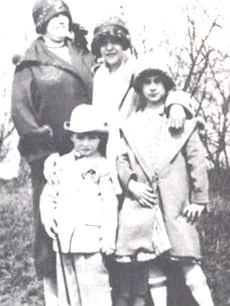
Image: Albert F. Budd Sr. / Asbury Park Press, 14 December 1934, p. 1. Public domain in the United States (published 1931–1977 without copyright notice). Via Wikimedia Commons.
The Budd Family
Grace Budd was born in Manhattan in 1918 to Edward Budd, a doorman, and Delia Budd, née Flanagan, who had immigrated from Ireland as a child. She was the second of six children. The family lived in a third-floor tenement apartment at 406 West 15th Street, between Ninth and Tenth Avenues, in what was then a working-class Irish neighbourhood of Chelsea. By all contemporaneous accounts Grace was quiet and devout; she had made her First Communion the year before her disappearance.
The Advertisement
On Sunday, 27 May 1928, Grace's eighteen-year-old brother Edward Jr. placed a short classified advertisement in the New York World. He was looking for work on a farm. The advertisement was answered the same week by a letter signed Frank Howard, Farmingdale, L.I., offering Edward a job on a Long Island farm at fifteen dollars a week with board. "Mr. Howard" proposed to call at the apartment the following Sunday to make the necessary arrangements.
"Mr. Howard" was Albert Fish.
3 June 1928
Fish arrived at 406 West 15th Street in mid-morning. He brought a small cloth bundle of pot cheese and strawberries as a gift. He was, by Delia Budd's later testimony, courteous and soft-spoken. Over the course of the morning he offered Edward Jr. the farm job; the paperwork, he said, was at his niece's apartment uptown. He suggested that Edward bring his younger sister along, because his niece was giving a children's birthday party that afternoon and Grace would enjoy it.
Grace was dressed in white — a silk dress, stockings, and a hat. Her mother allowed her to go. The time was 1:35 p.m. At the door, "Mr. Howard" said: "I will bring her back with me after the party." He did not.
The pair were seen boarding a Ninth Avenue el train. Fish took Grace by train and taxi to Wisteria Cottage, an empty house in Worthington, Westchester County, that he had previously visited. He killed her there that afternoon. Her remains were later recovered from the property.
Six Years Open
Detective William F. King of the Manhattan Missing Persons Bureau carried the case file from 1928 onward. Edward and Delia Budd were, for a period, regarded as suspects; the investigation took three separate men into custody on the basis of descriptions matching "Frank Howard," one of whom was held for three weeks before being exonerated. The case was reviewed at least annually. No body was recovered during the open period.
The investigation was resolved, six years and five months later, by the anonymous letter Fish posted to Delia Budd on or about 11 November 1934, and by Detective King's tracing of the envelope's printed letterhead.
Why This Case Defined the Prosecution
Fish was tried exclusively for the Budd murder. The Westchester County District Attorney, Frank Coyne, made a strategic decision to present a single indictment with a single strong evidentiary chain — the letter, the confession, and the physical evidence recovered at Wisteria Cottage — rather than risk a multi-count prosecution. The Gaffney confession and the McDonnell admission were entered into the record as relevant to the insanity defence but were not charged as separate counts. The jury's verdict in March 1935 was therefore, formally, a verdict for Grace Budd alone.
Grace is buried at St. John's Cemetery, Middle Village, Queens. The family left the West 15th Street apartment shortly after the 1934 resolution of the case and did not give press interviews after the trial.
See: the 1934 letter, Wisteria Cottage, all victims. Or return to the main archive.